Relationship Red Flags: Private Views, Public Beliefs
By Rafat Mahmood, Research Fellow at the ARC Centre of Excellence for the Elimination of Violence Against Women (CEVAW) and the Department of Economics, Monash University.
This post discusses findings from our recent project, "Warning signs of intimate partner violence: Personal opinions and perceived norms," co-authored with Uzma Afzal (RMIT University) and Sharon G.M. Koh (Monash University Malaysia).
Not all violence begins with a blow. Much of it begins with warning signs that many people are never taught to read: the partner who showers you with attention and then guilts you for seeing your friends; the one who insists "that's not what happened"; the one who quietly moves the savings into an account only he can reach. In the moment, these early "red flags" rarely look like abuse. But that’s exactly what makes them dangerous.
The scale of the problem is not in doubt. Globally, an estimated 26 percent of women have experienced physical or sexual violence from an intimate partner. In the United States, more than one in three women report lifetime exposure to sexual violence, physical violence, or stalking by a partner, and the latest National Intimate Partner and Sexual Violence Survey puts that figure at 34 percent. Violence also starts early: roughly one in four ever-partnered adolescent girls aged 15 to 19 have already experienced partner violence. If early recognition is a form of self-protection, then the years when young women are forming their first serious relationships are exactly when that skill matters most.
So how well do young women actually read these signs, and do they actually know what others around them believe?
Our approach
We surveyed 685 women across four racial and ethnic groups in the United States — White, Hispanic, Black, and Asian American – aged between 18 to 39. We showed each of them four short scenarios describing a male partner's behaviour: love bombing; gaslighting; financial control; and technology-facilitated tracking. Crucially, we never labelled the behaviours. Instead, participants read short scenarios describing different behaviours, such as love-bombing.
For each scenario we asked participants two questions. Firstly, we asked them “if you were in this relationship, how appropriate is his behaviour?” Secondly, we asked, “how appropriate would people in your community think it is?”
Asking both these questions lets us differentiate between what a person privately believes and what she assumes others believe in, a distinction that researchers of social norms argue is essential. The study was pre-registered before any data were analysed.
Some red flags are much harder to see than others
On average, women disapproved of all four behaviours. But they did not disapprove of them equally. Gaslighting and financial control drew sharp condemnation. Love bombing and phone tracking sat in a much greyer zone, rated only "somewhat" inappropriate.
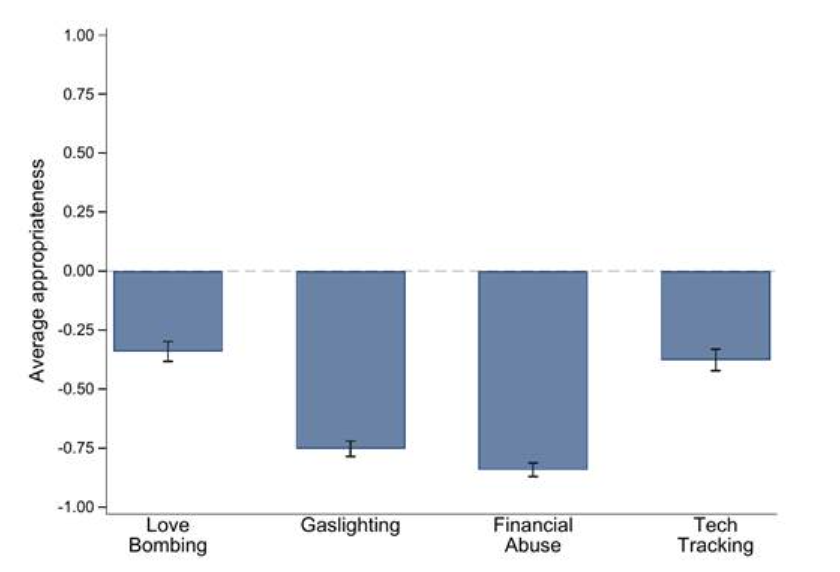
Figure 1. How inappropriate women personally judged each behaviour. Bars show the average appropriateness rating across all 685 women, from -1 (very inappropriate) to +1 (very appropriate). All four behaviours fall below zero, but gaslighting and financial abuse draw far sharper disapproval than love bombing and tech tracking. Whiskers are 95 percent confidence intervals.
That ambiguity carries a cost. When we asked whether each behaviour signalled an unhealthy relationship, about 90 percent flagged financial abuse and gaslighting, but only around 70 percent flagged love bombing and tech tracking. In fact, roughly one in nine read those behaviours as signs of a healthy relationship. In a world where couples already track each other's phones, constant location-sharing can even look like care. This echoes earlier work showing that subtler forms of control are far harder to recognise than overt aggression.
We also found an added nuance. A woman might rate an incident of relentless texting as inappropriate, yet still not conclude that the relationship itself is unhealthy. Among those who found love bombing inappropriate, about 16 percent did not go on to call the relationship unhealthy. Sensing that something feels wrong is one skill. Connecting it to a pattern of coercive control is another — and it is that second step that predicts future victimisation.
The gap that keeps people quiet
The most striking result is not about what women believe. It is about what they think everyone else believes. For every behaviour, women assumed their community was more tolerant of controlling partners than they were themselves. On average, participants perceived their peers to be about 20 percent more accepting than their own views. That gap was the widest for most clearly ‘abusive’ behaviours: gaslighting and financial control. In other words, women were not lenient. They just wrongly believed that everyone around them was.
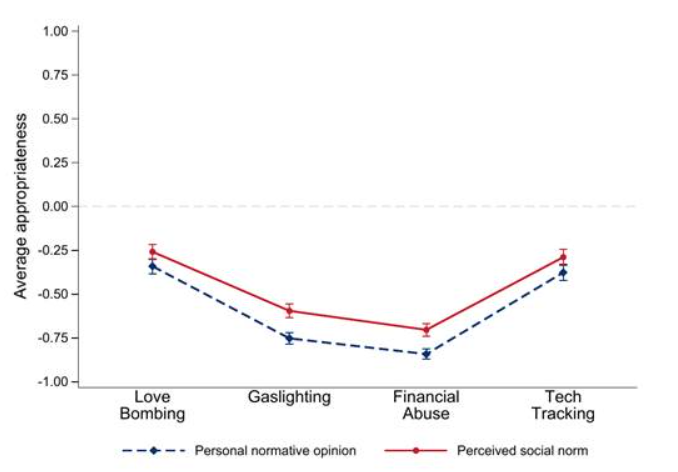
Figure 2. The norm gap. The dashed line shows what women personally think; the solid line shows what they believe their community thinks. For every behaviour the community line sits above the personal line, meaning women assume others are more tolerant than they themselves are. That gap is the signature of pluralistic ignorance.
This pattern has a name: pluralistic ignorance. Everyone privately objects, everyone assumes they are in the minority, and so no one speaks up. The silence itself becomes evidence that the behaviour is tolerated, and controlling conduct survives in a community that has, in fact, already rejected it. It is a close cousin of the finding, in a very different setting, that women's beliefs on what their neighbours think can shape whether harmful behaviour is excused.
But the gap was not identical across groups. Asian American women showed the largest misperceptions for gaslighting, financial abuse, and tracking, while Black women showed notably less for financial abuse. For anyone designing prevention programmes, public messaging, or frontline services, this variation matters. Correcting misperceptions works best when the message is tailored to the behaviours a community most misjudges.
This is actually good news. Here’s why
If young women held genuinely permissive attitudes, prevention would mean the slow, hard work of changing hearts and minds. Our results point to something more tractable: the attitudes are already in the right place. What is broken is the perception of consensus.
That suggests a different lever. Established violence-prevention frameworks already call for teaching healthy relationship skills, promoting positive relationship norms, and engaging peers and influential adults. Our findings point to a concrete task within that agenda. Rather than trying to change what women believe, we must demonstrate what their peers already believe – that most people in their community also see these behaviours as red flags.
Because the size of the misperception differs across communities, two things cannot be assumed. Firstly, what each community wrongly believes has to be measured locally. Secondly, correction is likely to matter most where the gap is widest.
Red flags are not predictions. They are patterns, and patterns can be learned, and shared. Young women have already done the hard part: recognising that controlling behaviour is wrong. The task now is to help them see that they are not standing alone.
Last updated: Sep 2026
Pillars
Pillar 1 - Causes/CostsWorkstreams
Social and Economic CostsKeywords
2026 Intimate Partner ViolenceAuthors
 Research Fellow Dr Rafat Mahmood
Monash University