Domestic Violence Fatality Reviews
By Lauren Bellamy, PhD Candidate, The University of Melbourne
What do DVFRs do?
Domestic Violence Fatality Review (DVFR) teams aim to reduce both fatal and non-fatal domestic and family violence (DFV). They review fatalities and examine human and system-related factors and then make recommendations for changes and improvements.
Specialised expertise in these reviews is critical for identifying where systems can better respond to DFV, while also raising awareness about its complex dynamics.
By collecting quantitative and qualitative data, these reviews offer ‘practical, implementable recommendations for change’. DVFRs have the potential to ‘transform the way agencies and stakeholders understand and respond to domestic violence’. This includes the potential to identify victims and perpetrators of DFV earlier by analysing interactions with systems like healthcare, law enforcement and social services. Although recommendations of the Australian state-level DVFRs are not legally enforceable and rely on voluntary implementation, they bring attention to the role that state-level agencies play in identifying, addressing and preventing DFV.
Differences across Australia
In Australia, all states and territories except Tasmania have their own DVFR mechanisms. Each functions under distinct operational and legislative frameworks, with variations in their composition, reporting requirements and responsibilities. To coordinate these state-level mechanisms and foster a national understanding of DFV fatalities, the Australian Domestic and Family Violence Death Review Network was established in 2011.
While the Network is not a national review body itself, it plays a crucial role in consistently recording and analysing DFV data across Australia and has worked with each state and territory to create a national minimum dataset.
However, consistently comparing data across Australia remains challenging due to differences in the approaches to death reviews and the type of data that each team has the power and resources to collect and review.
For example, in Western Australia (WA), the DVFR sits within the Ombudsman’s office and reviews deaths referred by the WA Police. This referral process differs from teams that sit within the coroner’s office. The WA Police refer fatalities to the DVFR if the individuals involved are considered to be in a ‘family relationship’ (s 4 Restraining Orders Act 1997). This definition is narrower than other states and seemingly excludes ‘collateral homicides’, where bystanders or third parties are killed. As a result, while these deaths are investigated by police and potentially at coronial inquest, they may not be reviewed by the DVFR team. This means that information pertaining to these deaths would be excluded from the data they compile and provide for national collation. This seemingly minor difference highlights the challenges of consistent classification and review across Australia.
In South Australia (SA), the DFV research officer role was defunded in 2021, leading to a loss of specialised DFV-informed investigation. As a result, the coroner now has sole responsibility for considering the impact of DFV in fatalities. While the previous DFV research officer still sits on the National Domestic Violence Death Review Network, it is unclear how the removal of this role has impacted DFV data collection in SA for national comparison.
The DVFR model was first introduced in San Francisco in 1991 and has since spread to 46 US states, as well as internationally to countries such as Canada, the United Kingdom, Portugal, New Zealand and Australia.
Examples of different international DVFR approaches
DVFRs have been widely adopted globally, but the types of fatalities reviewed and the review structure vary significantly.
Community Approach
In Montana, USA, a community-centred model through the Domestic Violence Fatality Review Commission highlights the importance of local engagement in addressing DFV fatalities. This model aims to develop targeted interventions that align with the unique challenges and strengths of each community. It not only improves the effectiveness of reviews but also enables communities and impacted families to take an active role in DFV prevention. However, this approach is resource intensive, and the comparability of data may be limited.
State/Province Approach
The Ontario DVFR combines expertise from law enforcement, healthcare and social services through a multi-disciplinary advisory committee. This committee examines DFV deaths and develops recommendations to prevent similar deaths. Unlike community-level reviews, state/provincial teams generally exclude families or perpetrators, focusing instead on system contact points and systemic change.
However, DVFRs at the state/provincial level may be constrained by the federal/state divide, impacting factors considered across countries. For example, in Canada, the family law system operates at both federal and provincial levels, falling within the scope of state/provincial DVFRs for review. Conversely, in Australia, the family law system is a federal system and may be seen as outside the purview of state-level DVFRs.
National Approach
The New Zealand/Aotearoa (NZ) Family Violence Death Review Committee (FVDRC) was established in 2008. It has four regional review teams which conduct in-depth death reviews at the local level and report back to the national committee. As NZ is a unitary state, the national government has power over all areas of law. This means the FVDRC can assess and provide recommendations about all system contact points (e.g. family law, nationwide police and healthcare contacts) without facing jurisdictional divide issues encountered in countries like Australia, Canada and the USA.
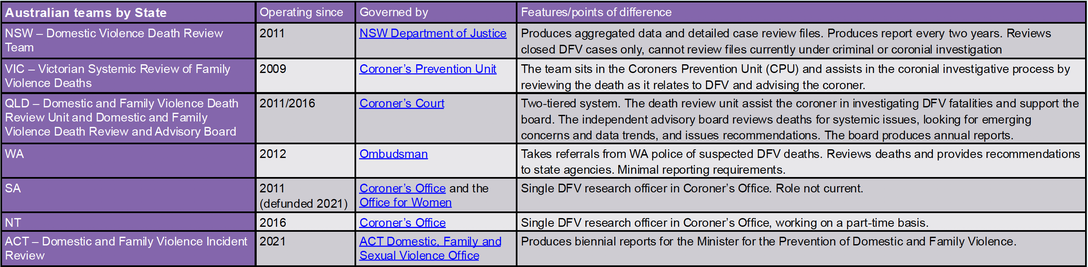
Australian Domestic Violence Fatality Review teams by State
Suggested Citation:
Bellamy, L. (2025, June). Domestic violence fatality reviews [Information sheet]. Centre of Excellence for the Elimination of Violence Against Women (CEVAW). https://doi.org/10.26188/28319510
Last updated: Dec 2025
Pillars
Pillar 3 - ResponsesWorkstreams
Legal ResponsesKeywords
Domestic violence LawAuthors
 Lauren Bellamy
The University of Melbourne