Legal Responses to Domestic Violence: Global Insights for Policy and Practice
Countries with domestic violence laws report significantly lower rates of intimate partner violence – but the type of law matters.
Problem Statement
Domestic violence (DV) remains one of the most widespread human rights violations, affecting nearly one in three women globally. While most countries have now adopted DV laws, progress in implementation and enforcement remains uneven. This study examines how the presence, type, and comprehensiveness of DV laws relate to intimate partner violence (IPV) prevalence worldwide.
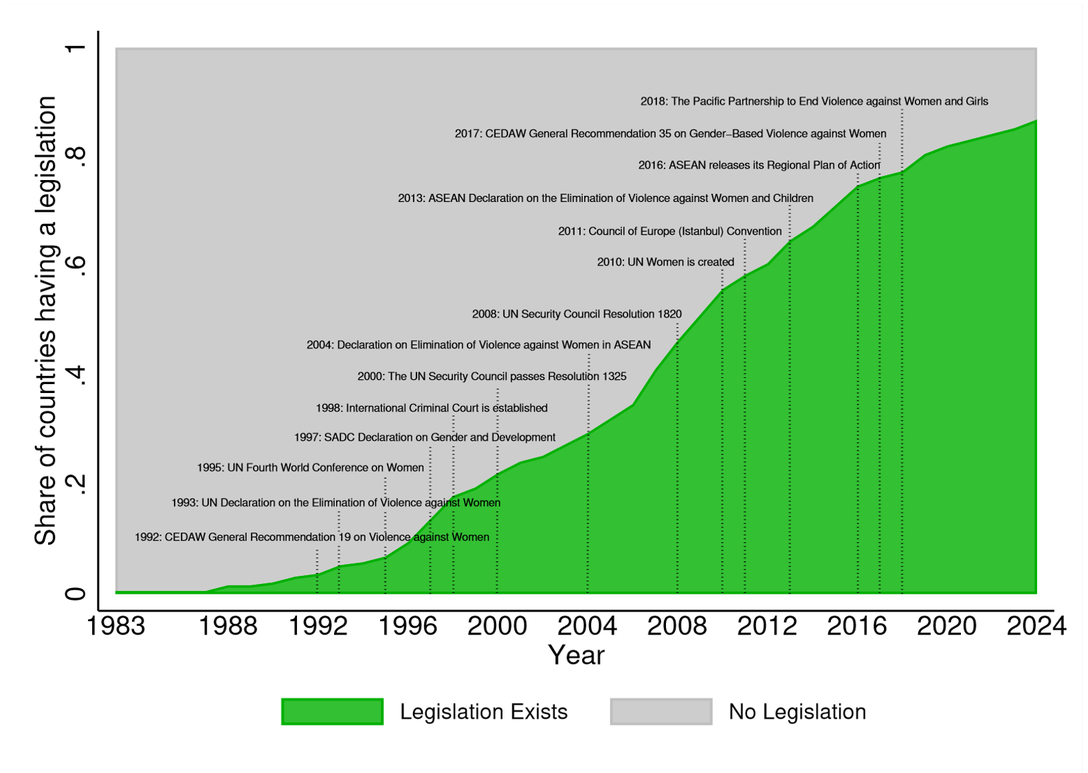
Figure 1: Share of countries adopting DV laws and key international events on violence against women, 1983–2024. Most countries adopted DV laws after 1995, following key international commitments.
Key Findings
DV laws correlate with lower violence rates
Countries with DV laws report about 22% lower rates of IPV.
Dedicated DV laws are more effective than general provisions
Laws focused specifically on DV, such as those adopted in Australia, are more closely linked with better protection outcomes than broader family or gender-based violence laws.
Multiple complementary laws provide stronger protection
Countries with several legal instruments addressing DV, such as dedicated DV laws alongside criminal code provisions, as seen in Vietnam, show more comprehensive and consistent protection frameworks.
High-income countries adopted laws decades earlier than lower-income regions
High-income and Latin American countries have widespread laws; in contrast, many countries in Sub-Saharan Africa and the Middle East and North Africa still lack comparable legal measures.
Strong governance and women’s rights amplify law effectiveness
Lower levels of IPV are observed not only in countries with strong DV laws, but also where governance is stronger, income levels are higher, and women enjoy greater economic and political rights, as demonstrated by Ireland.
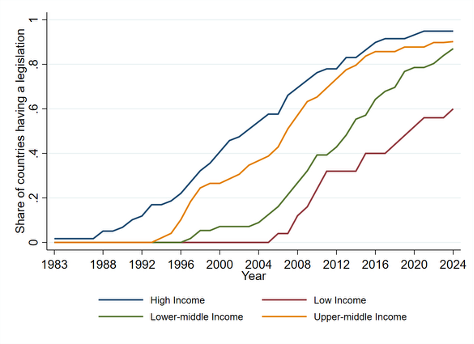
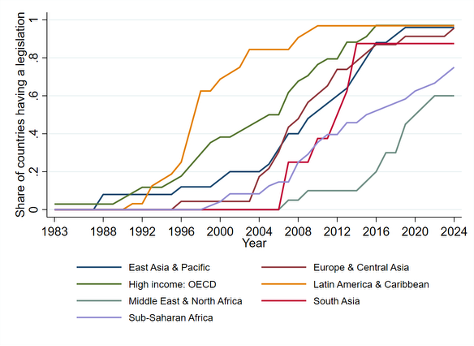
Figure 2: Diffusion of legal norms by region and income group, 1983–2024. High-income regions adopted comprehensive DV laws decades earlier than low-income regions.
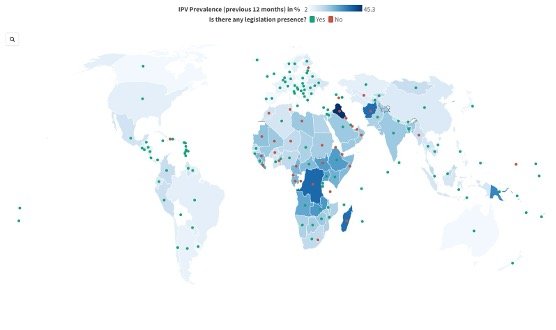
Figure 3: Presence of DV laws and IPV prevalence in the previous 12 months, 2018. Countries with DV laws show lower IPV prevalence.
Implications for Policy and Practice
DV legislation is an essential foundation for national responses to violence against women, but laws alone are not enough. Their impact depends on how they are designed, enforced, and supported within broader gender equality systems.
Countries that combine strong DV laws with robust institutional frameworks, including law enforcement, accessible support services, and adequate funding, tend to achieve better protection outcomes. Ultimately, progress in addressing IPV requires coordinated efforts that link legislation with practical implementation.
Recommendations
Adopt and strengthen stand-alone DV legislation
Ensure coverage of all forms of violence: physical, sexual, psychological, and economic.
Invest in implementation systems
Train police and judicial officers, expand access to shelters and legal aid, and fund monitoring mechanisms.
Enhance data and accountability
Improve collection of IPV and DV data and publish enforcement outcomes regularly to track progress as highlighted in the annual report by Domestic, Family and Sexual Violence (DFSV) Commissioner.
Read the Full Study
Fisher, J., Lukas, E., Mavisakalyan, A., & True, J. (2025). Regulation of domestic violence: a global perspective. BMC Public Health, 25(1), 1-14. https://doi.org/10.1186/s12889-025-24489-z
Last updated: Nov 2025
Pillars
Pillar 1 - Causes/CostsWorkstreams
Prevalence and Change Impact of InstitutionsKeywords
LawAuthors
 Professor Jacqui True
Monash University
Professor Astghik MavisakalyanCurtin University
Professor Jane FisherMonash University
Erica LukasThe University of Western Australia